
Prime Minister Narendra Modi on Tuesday said resumption of talks with Pakistan was to "try and turn the course of history" and to bring an end to terrorism, but made it clear that the neighbouring country would be judged by its commitment on terrorism.

India must also not rule out dialogue with Pakistan. However, talks with Pakistan must be structured, and further progress must be based on visible results.

The allocation in the defence budget is inadequate to meet India's long-term threats, especially from China and Pakistan, says Gurmeet Kanwal.

The CDS has the option to focus on key areas of capability development to fight new generation wars or get bogged down in trying to bring cosmetic changes to humour the political leadership, asserts Brigadier Narender Kumar (retd).
The Xi Jinping regime might try to quell internal distress by directing nationalism and militarism against India, warn Ajay Shah and Gautam Bambawale.

The relation between India and China has broad influence on Asia's security and the United States will continue to engage with them to encourage regional stability, the nominee for the Pentagon's top policy post for the Asia-Pacific region said.

Chinese President Hu Jintao on Friday got the backing of the country's powerful military for his call to retain the supremacy of the Communist Party over the army, measures to speed up defence modernisation and the war against corruption.
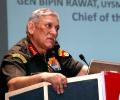
Citing China's example, he said a powerful military will enhance India's strategic clout.

China will use airpower to support Pakistan from the start of a war. China will use the opportunity to at least take Ladakh. Its growing navy will prevent India from blockading or attacking the Makran Coast. And thanks to Chinese weapons, Pakistan keeps expanding its forces, observes Ravi Rikhye.
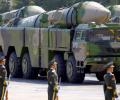
China is expanding its nuclear force and is likely to have a stockpile of about 1,500 warheads by 2035, up from the current estimated number of 400, the Pentagon has said in a report that notes that Beijing aims to expand its national power through both domestic and foreign policy initiatives.
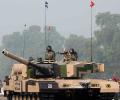
Senior Colonel Liu Degang said the Arjun tank is "very good" and suits Indian conditions.
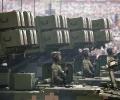
China hiked its annual defence budget by 7.1 per cent.

China has been taking "incremental and tactical actions" to press its claims at the Line of Actual Control (LAC) with India and has unsuccessfully sought to prevent New Delhi from deepening its relationship with the US during and subsequent to the standoff, the Pentagon has said in a major report on China's military modernisation.

Excluding the pension outgo, the allocation in the Union Budget for the armed forces stands at Rs 3.62 lakh crore.

Prime Minister Narendra Modi on Tuesday said the people have given his government a mandate for stability and continuity for the third consecutive term after seeing its work of 10 years and accused the Congress of trying to build a narrative that it has defeated the Bharatiya Janata Party-led National Democratic Alliance in the Lok Sabha polls.

The prime minister was briefed by Chief of Defence Staff Gen Anil Chauhan about the various discussions conducted at this year's Combined Commanders' conference.

Tillerson said the US will provide India with best technologies for its military modernisation which include offers to supply F-16 and F-18 fighter jets.

Three people were killed after the MiG-21 fighter aircraft crashed into a house in Hanumangarh in Rajasthan shortly after it took off for a routine training sortie from the Air Force Station at Suratgarh.

'Given the possibility that our unstable northern and western borders may become 'live' at short notice, any major systemic change which impacts combat effectiveness should be brought about in a cautious and progressive manner.'

A powerful senatorial committee on Wednesday is set to consider a bipartisan resolution to recognise Arunachal Pradesh as an integral part of India, pushing back against China's military aggression to change the status quo along the Line of Actual Control.

Chinese President Xi Jinping on Sunday said the People's Liberation Army has the confidence and capability to defeat all invading enemies as he inspected a massive military parade at the country's largest military base to mark the 90th founding anniversary of the 2.3-million strong army.
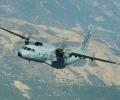
The C295 is known to be a superior aircraft used for tactical transport of up to 71 troops or 50 paratroopers, and for logistic operations to locations that are not accessible to current heavier aircraft.

Taiwan considers itself a sovereign state -- but China views the self-ruled island as a breakaway province. Beijing has not ruled out the possible use of force to achieve unification.

Coming down hard on the government for meagre increase in allocation for armed forces in the last few years, the Parliamentary Standing Committee on Defence said the outlay cannot even fulfill the basic requirements of the armed forces.
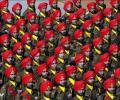
The finance minister hiked the total defence expenditure from Rs 203,672 crore in FY 2013-2014 to Rs 229,000 crore for FY 2014-2015. Though the increase appears substantial, it is insufficient to undertake the military modernisation necessary to meet the emerging threats, feels Brigadier Gurmeet Kanwal (retd).

The PM's vision of a lean, agile, mobile and technology driven force requires more than 1.7 percent of GDP that it now gets.

The American platforms at the exercise 'Cope India' that started off Kalaikunda will also include a fleet of F-15 E fighter jets, C-130 and C-17 transport aircraft.

The best available recourse to keep the defence sector healthy, is to source most of our requirement within the country so that procurement outlays under both the Revenue and Capital heads flow within the country, recommends says Brigadier S K Chatterji (retd).
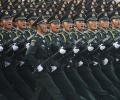
Protests at this time when efforts are underway to strengthen the PLA and keep morale high would be worrying for the military leadership, observes Jayadeva Ranade, the retired senior RA&W officer and distinguished China expert.

'Many senior officers are unhappy with him, but many lower level officers are still supportive.' 'This is also not something that has happened for a long time. So this is certainly a milestone.'

It is worrisome that salaries are consuming as much expenditure as equipment.

Among others, China is developing the strategically located Gwadar port in Balochistan, which is aimed towards having a military presence, says a Pentagon report

'India was in no position to wage another war in 1965, having suffered a morale-shattering defeat in 1962. The three services were in the middle of a modernisation and expansion phase and therefore not fully trained or battle-ready.'

In a few years from now, India will be looking at an entirely different type of military adversary across the borders, in our waters, in the air, in space and in our communication networks, says Nitin Pai.
The incursions, according to Taiwan, were made by aircraft, including 12 J-11, 6 J-10, 18 J-16, six SU-30, CH-4, WZ-7, Y-8 EW, Y-8 ESW and KJ-500.

'It is the government's most important duty to ensure that when war breaks out, the armed forces are absolutely ready to face the adversary -- well equipped, well trained and in high spirits,' says Brigadier Gurmeet Kanwal (retd).

Pentagon has sought direct dialogue between India and China 'free of any coercive aspects'.

Chinese Foreign Minister Qin Gang reiterated that the situation at the India-China border is generally stable and both sides should consolidate the present achievements and strictly abide by the relevant agreements while pushing for further cooling and easing of the conditions for sustainable peace and tranquillity at the frontier.
A new military rank system had been introduced for the PLA, but all soldiers must always obey the Communist party, reveals Jayadeva Ranade, the distinguished China expert and retired RA&W officer.

Amidst growing tension with China over a suspected surveillance balloon, US President Joe Biden has said that the United States will act to protect if Beijing threatens its sovereignty.
